Key Takeaways
- Artisans making traditional instruments can get global attention by mixing old-school craft with modern engineering, just look at how the St. Augustine Steelpan Workshop uses CAD software to nail down tone.
- Getting international partners, like the St. Augustine workshop’s deal with a German acoustics research institute, opens doors to serious R&D and a bigger market.
- You have to protect your IP. Patenting unique tuning methods or material treatments is how you keep your competitive edge and stop copycats.
- Smart digital marketing, especially high-quality videos that show off the instrument’s sound and build process, is how you reach a global audience and explain complex technical details.
The sound of a hammer on steel, once a fixture of backyards in Trinidad and Tobago, is now echoing worldwide. That change wasn’t an accident. It came from dedicated artisans who figured out how to blend their centuries-old craft with 21st-century engineering. So how does a niche instrument made from old oil drums get that kind of traction in a world of digital music?
The Challenge of Consistency: A Craftsman’s Dilemma
For generations, building a steelpan came down to a master tuner’s ear and muscle memory. Take Marcus “Panman” Dubois, a third-generation pan builder from Laventille, Trinidad. His grandfather, a pioneer back in the 1940s, taught him everything: how to sink the steel, groove the notes, and temper the metal. Marcus didn’t just inherit tools. He inherited a feel for the steel’s sonic possibilities. By the late 1990s, though, he had a big problem. How could he scale up his workshop’s production without losing the quality his family was known for? Each pan he made was one-of-a-kind, which sounds great, but that individuality made it nearly impossible to fill large international orders. Orchestras in Europe and Asia wanted full sets of pans that sounded identical and behaved predictably in different climates. “We would get orders for full orchestras, 50 or 60 pans,” Marcus told the Trinidad and Tobago Guardian (https://www.guardian.co.tt/news/local/2024-03-15/steelpan-innovation-a-global-sound) in a 2024 interview. “But to make every tenor pan sound exactly like the last, and then match it perfectly with the double seconds and cellos? That was a monumental task. The slightest variation in steel thickness or tempering could throw off an entire set.” This inconsistency was the main barrier to wider adoption, keeping the steelpan in the hands of enthusiasts instead of serious orchestral institutions.
Embracing Technology: A New Approach to an Old Art
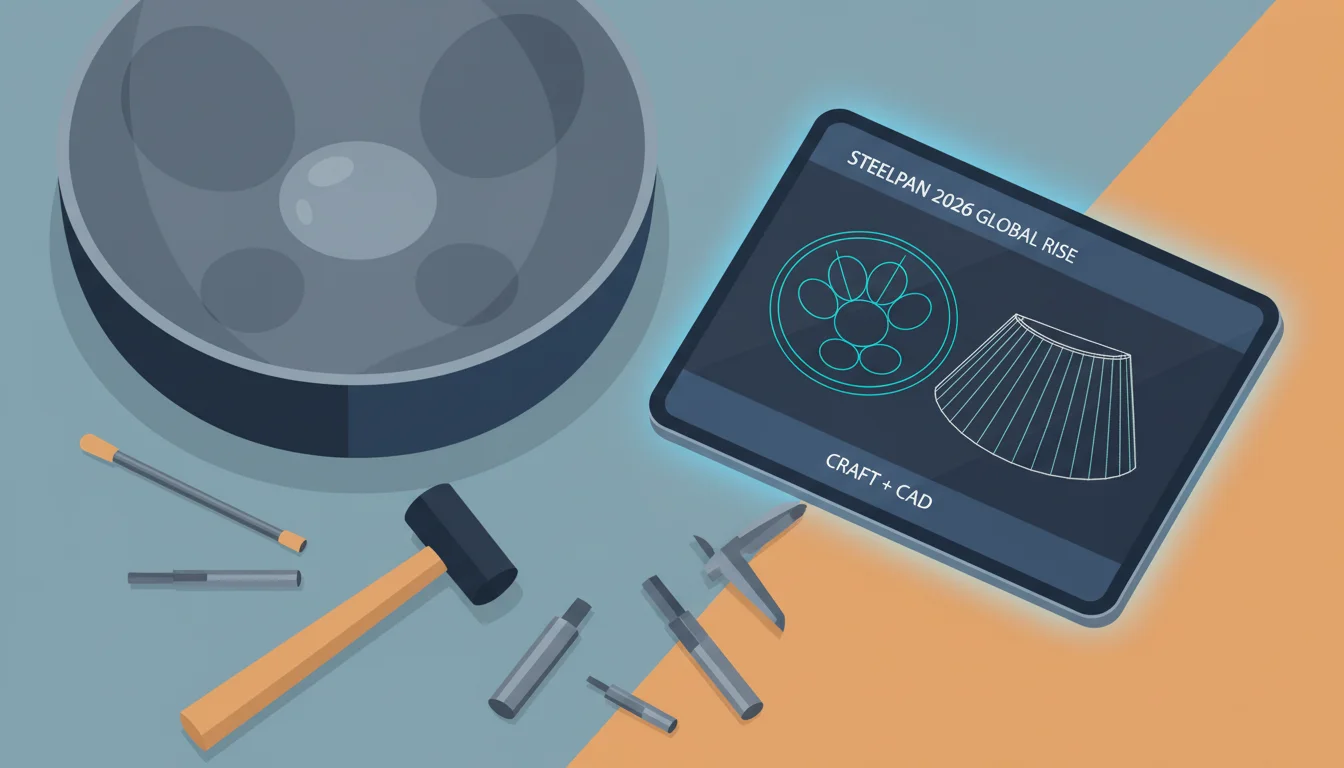
To get his family’s craft on the world stage, Marcus knew he had to look beyond the old ways. In 2018, he started working with acoustical engineers from the University of the West Indies, St. Augustine campus. Their shared goal was to inject precision engineering into the very organic, hands-on process of building a pan. Their first big step was in material science. Marcus and the team worked with metallurgists to test different grades of steel, analyzing their molecular structures and responses to heat. They found that certain alloys, when put through a controlled tempering process in industrial ovens, had much more uniform stiffness and resonance than the old repurposed oil drums. The point wasn’t to replace the craft, but to give the tuner a better, more predictable canvas to work with. “We weren’t losing the soul of the pan,” Marcus said at a 2025 World Music Expo panel in Berlin. “We were just giving it a stronger, more predictable body.” Then they started using digital tools. The team used Computer-Aided Design (CAD) software to map out the exact dimensions of every note on the pan’s surface. With high-resolution laser scanners, they could capture the precise curves and depths of famous, historically great pans, creating digital blueprints of what acoustic perfection looked like. They even developed their own software that analyzed the steel’s vibrational patterns, letting them predict how different hammer strikes would change the final tone. This modeling cut down on the endless trial-and-error of traditional tuning, which sped up production without hurting quality.
Building Bridges: International Collaborations and Recognition
The St. Augustine Steelpan Workshop, the new name for Marcus’s operation, started getting noticed. Their scientific approach, backed by Marcus’s obvious skill as a tuner, caught the eye of some big international players. In 2023, they landed a research grant from the German Federal Ministry of Education and Research to work with the Fraunhofer Institute for Digital Media Technology (IDMT) in Ilmenau. Partnering with the IDMT, famous for its work in audio processing and acoustics, changed everything. They gave Marcus access to advanced labs and expertise that helped him dial in the steelpan’s sound even further. A key result from this work was a standardized tuning methodology, basically a recipe for getting specific tonal qualities. This method, now partially patented, uses laser interferometry to make precise measurements of note depth, surface tension, and harmonic overtones. A joint press release from Fraunhofer and the workshop in January 2026 stated this new process cuts tuning time for a single tenor pan by up to 30% while guaranteeing a near-perfect match across a whole orchestral set. This was exactly the kind of consistency orchestral directors needed. Global recognition came quickly after that. The workshop was invited to show their instruments at the 2025 NAMM Show in Anaheim, California, a huge event for the music industry. Their booth had live demos that showed both the hand-hammering craft and the new digital analysis. The response was strong. Several university music departments, including the Berklee College of Music in Boston and the Royal Academy of Music in London, put in orders for full sets of the engineered pans. They saw an instrument that had both cultural soul and technical precision. “What Marcus and his team have achieved is remarkable,” Dr. Eleanor Vance, head of Ethnomusicology at Berklee, told Music Trades Magazine (https://www.musictrades.com/news/2025/09/22/steelpan-innovation-hits-high-note/) last September. “They’ve taken an instrument that was often seen as an exotic novelty and elevated it to a level of orchestral sophistication comparable to any classical instrument. The consistency of their tuning allows for complex arrangements that were previously challenging to execute with traditional pans.”
Protecting Innovation and Sustaining Growth
All this global attention brought a new problem: protecting their intellectual property. The St. Augustine Steelpan Workshop knew their methods were valuable. Filing patents for their specialized steel tempering process and proprietary acoustic software did more than just protect their work from being copied. It cemented their reputation as leaders in the field which attracted more research partners and investors. Their marketing shifted from simple word-of-mouth to focused digital campaigns. They produced high-definition videos for platforms like Vimeo and music forums, showing the detailed craft, the science behind it, and of course, the incredible sound of the pans. Featuring testimonials from respected musicians and conductors gave them instant credibility. They also built out a solid e-commerce presence which let international customers configure and order custom sets of pans directly from the workshop, complete with detailed specs and tracking.
The Future of a Resurgent Instrument
Marcus Dubois’s story, moving from a traditional craftsman to a leader in his field, is a practical blueprint. His success proves that you can respect heritage while still pushing forward with new technology. By welcoming scientific methods, he didn’t just save an art form, he launched it onto the world stage. The St. Augustine Steelpan Workshop now has a staff of over 30 artisans and engineers, showing that this blend of old and new is a viable business model. Their order books are full for the next year and a half with requests from symphony orchestras, schools, and professional bands in more than 40 countries. They’re selling more than instruments. They’re exporting a carefully refined piece of Trinidadian culture that people all over the world can appreciate. The lesson from the St. Augustine Steelpan Workshop is that cultural innovation takes off when artisans are willing to challenge their own methods and bring in new expertise. If you want to take a traditional craft global, you need a serious plan for quality control, smart tech adoption, solid IP protection, and a marketing strategy that actually reaches people online.
What challenges did traditional steelpan builders face in achieving global recognition?
They primarily struggled with inconsistent tonal quality, which made it almost impossible to produce matched orchestral sets. The process was also slow and couldn’t scale for big international orders, keeping the instrument from being adopted by major musical institutions.
How did technology help modernize steelpan construction?
They used Computer-Aided Design (CAD) for mapping note layouts, laser scanners for copying great historical pans, and special software to analyze vibrations. These tools made the pans more consistent and sped up the tuning process while improving acoustic quality.
What role did international partnerships play in the workshop’s success?
Working with groups like Germany’s Fraunhofer Institute for Digital Media Technology (IDMT) gave them access to top-tier R&D labs. These collaborations helped them develop standard tuning methods and gave them huge credibility which led to orders from prestigious music academies.
How did the St. Augustine Steelpan Workshop protect its innovations?
They filed patents on their specific steel tempering process and the proprietary software they developed for acoustic analysis. This legal protection kept others from copying their work and established them as the experts in the field, attracting more investment.
What marketing strategies were employed to reach a global audience?
They moved online with targeted digital campaigns, using high-def videos on platforms like Vimeo to show off the instrument’s sound and construction. They also built an e-commerce website for direct international sales and used testimonials from well-known musicians.



