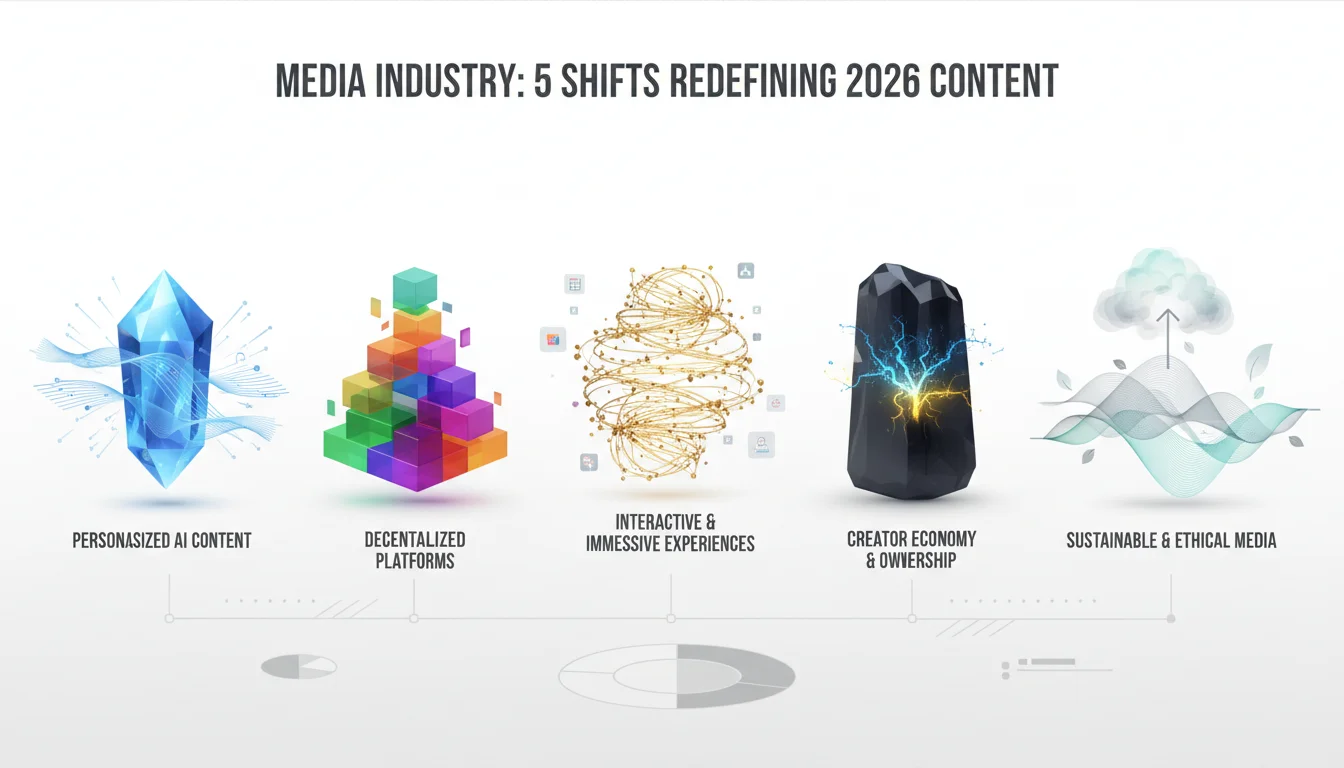
The media industry is in the middle of a massive shakeup in 2026, driven by new tech, splintered digital platforms, and completely different consumer habits. Old-school broadcasting is losing its audience fast as streaming services multiply, forcing content creators and distributors back to the drawing board. This is a full-blown structural realignment hitting everything from production budgets to ad revenue. So what actually defines this new content era, and how’s it going to change what we all watch?
Key Takeaways
- Competition for subscribers is about to get fierce, with global SVOD penetration expected to hit over 70% of internet users by 2028, making retention the name of the game.
- AI content generation tools are slashing production costs for niche shows, which means we’re about to see a flood of hyper-targeted programming.
- Ad money is fleeing linear TV for connected TV (CTV), with US CTV spending on track to top $30 billion by 2027, and nobody has a great model for measuring it yet.
- Indie creators on platforms like Patreon and Substack are going direct-to-consumer and stealing big chunks of the audience, bypassing the old media gatekeepers.
- There’s a desperate need for a common data standard because without one, tracking engagement across platforms to prove ROI to advertisers and producers is a complete mess.
The Primacy of Personalization: Beyond the Algorithm
Personalization in media used to just mean Netflix’s algorithm suggesting your next binge based on what you’ve already watched. But 2026 is an inflection point where personalization has moved into active co-creation and hyper-segmentation. People now expect content that feels made specifically for them, and in some cases, they want a hand in making it. We’re seeing this in the market for interactive narratives, where a viewer’s choice can send the plot in a new direction, a format being tried on platforms like Hulu and even in gaming experiences that blur the line between watching and playing.
A 2025 Pew Research Center report backs this up, showing that almost 60% of Gen Z and Millennial viewers want more control over what they consume, including the ability to tweak storylines. The point is to offer a spectrum of engagement. It’s happening already when you see fan-fiction communities actually influencing the direction of a mainstream show, or when a creator on Twitch lets live audience feedback guide the broadcast. The big challenge for media conglomerates is that their slow, rigid production cycles just can’t keep up with this demand for dynamic, responsive content. It forces a change from a top-down broadcast mentality to a continuous conversation with the people watching.
I’ve been watching this field for over a decade, and my take is simple: any company that isn’t building audience feedback directly into its development pipeline is going to become irrelevant. Post-release surveys are too little, too late. The audience now expects media to be a living thing that they help shape. This obviously creates huge headaches for traditional intellectual property management, demanding more flexible licensing and collaboration that a lot of the old guard is scared to try. But the data is clear. Building a community around your content, instead of just dropping it on a platform, is what creates real loyalty and wins the long game.
The Great Unbundling and Rebundling: Streaming Wars Evolve
Remember when we all ditched cable for a bunch of separate streaming services? That was the great unbundling, roughly from 2015 to 2023. We loved the choice, right up until “subscription fatigue” and the climbing monthly bills hit hard. Now, in 2026, the market’s swinging back toward strategic rebundling, but it looks nothing like your parents’ old cable package. This new phase is all about partnerships and niche aggregation to create value that goes beyond just having a big library of shows.
Big players like Disney and Warner Bros. Discovery are trying out tiered subscriptions, often with cheaper ad-supported options to get people in the door. We’re also seeing some strange bedfellows team up for bundles. A recent Reuters report, for example, mentioned a pilot program where Paramount+ and Peacock are offering a combined sports-and-entertainment package at a discount in certain cities. It’s a clear admission that people won’t pay for every single service, but they might bite on a curated package that feels like a good deal.
The main difference from old cable is the flexibility. You can still opt out. The problem is that with so much content scattered everywhere, just finding something good to watch is a real chore. This has opened the door for specialized aggregators and content curation platforms to act as personalized media dashboards, pulling from all your subscriptions into one clean interface. These services do more than just search. They offer smart curation that learns your tastes across dramas, documentaries, and even live virtual events. The fight for your attention is now about who can best help you navigate the ocean of options, not just who has the one big exclusive show.
AI’s Dual Role: Enhancer and Disruptor
In media, AI isn’t some far-off idea anymore. By 2026, it’s a tool that’s already embedded in daily workflows, both improving old processes and blowing up entire paradigms. On the enhancement side, AI is changing post-production by automating a ton of work like video editing, color correction, and generating temp voiceovers. An AP News article recently reported that some big studios are using AI to cut post-production time by as much as 30%, which lets them either push out more content with the same budget or just make their current projects look more polished.
The disruptive side of AI is far more deep. We’re seeing AI-generated content (AIGC) move past basic text and images to create entire videos and interactive experiences. While a fully AI-generated blockbuster isn’t quite ready for prime time, look at what niche creators are doing with tools like RunwayML and Synthesys. They’re churning out high-quality explainer videos and marketing materials for a tiny fraction of the old cost and time. This democratizes everything. If one person can generate a decent animated series from their laptop, what does that mean for a giant animation studio with a huge payroll?
Naturally, this brings a firestorm of ethical questions about copyright, IP ownership for AI works, and the obvious risk of deepfakes and misinformation. The European Union’s AI Act is already setting rules for transparency that will affect media producers everywhere. My view is that AI isn’t going to replace human creativity, but it will absolutely change what it means to be a creative professional. The future is human-AI teams, where the AI handles the repetitive grunt work, freeing up people for the big ideas, emotional depth, and strategy. People who adapt to this collaborative model will thrive. Anyone who resists it is going to get outmaneuvered.
The Creator Economy’s Maturation: Beyond Influencers
By 2026, the “creator economy” means a lot more than just social media influencers. It has grown into a serious force in the media business, evolving from individual personalities on YouTube into sophisticated micro-studios with their own production teams and distribution plans. These aren’t just ad-hoc producers anymore. Many are running full-fledged businesses.
The big change is the drive toward ownership and getting paid directly by the audience. Platforms like Shopify have let creators build their own e-commerce operations to sell merchandise or digital products. At the same time, Web3 tech is letting them build tokenized communities that offer exclusive content or voting rights to their biggest fans, completely bypassing the old middlemen. This whole model builds a much tighter community and gives creators financial independence, so they’re not at the mercy of ad markets or some random algorithm change.
This puts traditional media companies in a tough spot. Why would a talented storyteller pitch their series to a network and give up control, when they could build an audience of 50,000 paying subscribers on their own and keep all the creative freedom and most of the money? The truth is, they increasingly won’t, unless the network’s offer is amazing. This is forcing the big media players to stop treating talent as a resource to be mined and start offering real, creator-friendly partnerships. The balance of power is shifting, and creators are holding much better cards now, thanks to technology and that direct line to their fans.
What’s happening in the media industry isn’t just a blip. It’s a fundamental reordering of how content gets made, distributed, and consumed. Success in this environment requires agility, a real understanding of what audiences want, and a willingness to use new technology while sorting out the ethical messes. The future of content will be led by those who can nail personalization, build smart partnerships, use AI wisely, and truly support creators.
How are traditional media companies adapting to the rise of streaming services?
They’re mostly launching their own streaming platforms, creating hybrid subscription models with both ad-free and cheaper ad-supported plans, and pouring money into original content to stand out. Many are also forming partnerships and licensing content to each other to grow their audience and avoid head-to-head battles on every front.
What impact will AI have on content creation jobs?
AI will likely automate a lot of the grunt work in content creation, think basic video edits, sound mixing, or creating simple graphics. This probably means job roles will shift more toward high-level creative direction and big-picture strategy. While some tasks might disappear, new jobs are already popping up for things like AI prompt engineering, managing AI tools, and ensuring AI-generated content is used ethically.
Is the “creator economy” sustainable in the long term?
It’s looking very sustainable because creators aren’t just relying on ad revenue anymore. They’re diversifying with direct subscriptions from fans, selling merchandise, offering digital products, and making deals with brands. By building a direct relationship with their audience and owning their distribution, they’re less vulnerable to the whims of a single platform, which gives them a much better shot at long-term success.
How is content personalization evolving beyond simple recommendations?
It’s going way beyond simple recommendations. We’re seeing more interactive stories where the audience’s choices matter, integration of user-generated content, and even content that adapts in real-time to how you’re engaging with it. This can mean anything from letting viewers influence a plot to participating directly in a live broadcast, creating media that feels tailored to specific interests.
What are the biggest challenges facing the media industry in 2026?
The big ones are combating “subscription fatigue” among consumers, figuring out how to actually make money when the audience is so fragmented, and dealing with all the ethical and legal headaches of AI-generated content, especially around copyright. On top of that, holding onto top talent is getting harder because creators have more power and can just go independent.



