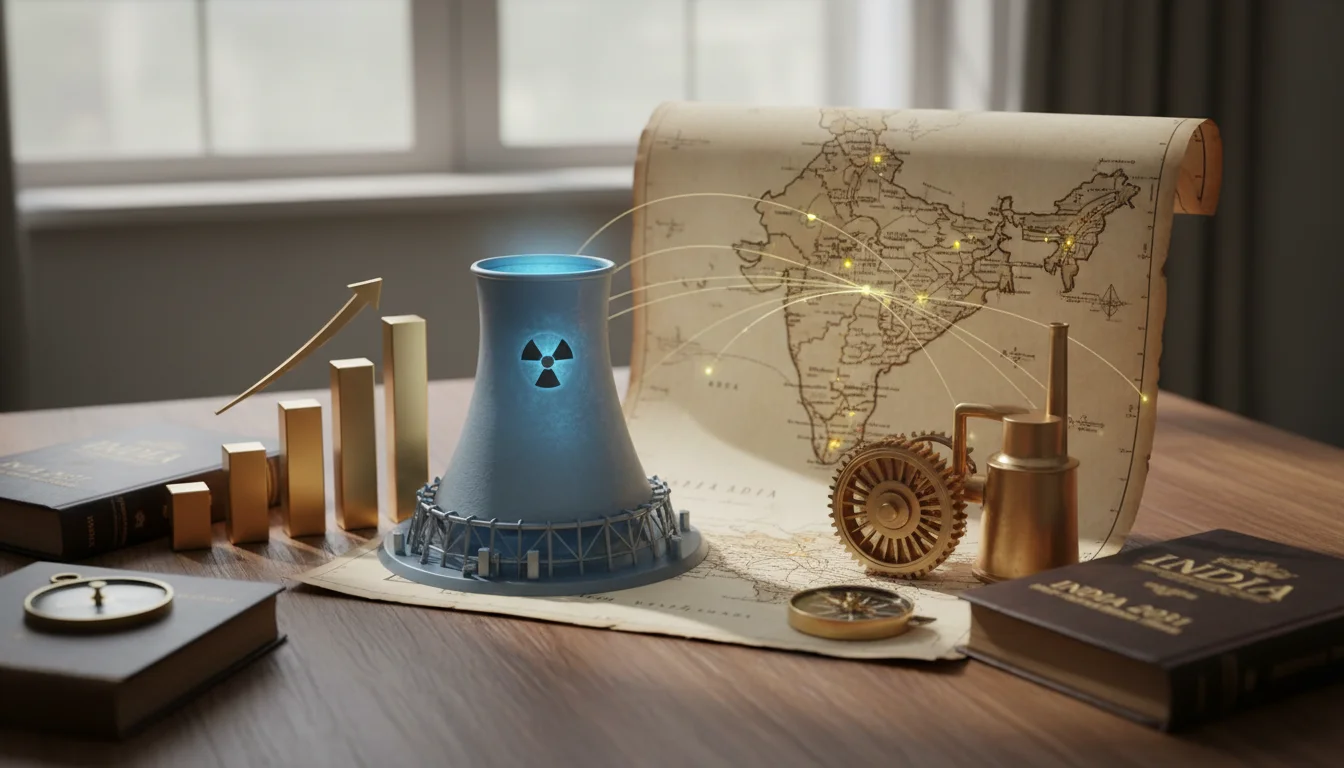
India’s push for more nuclear power is getting serious, driven by a simple reality: its growing population and expanding industry need a lot more electricity. Energy security is the top concern here. Expanding the nuclear fleet is foundational for economic development and for getting off fossil fuels. The real test is how India will balance this rapid growth with the huge complexities of a nuclear build-out.
Key Takeaways
- The goal is to hit 22,480 MW of nuclear capacity by 2031, with a bunch of new reactors already being built or on the drawing board.
- India’s long-term play revolves around homegrown tech like advanced heavy water reactors (AHWRs) and fast breeder reactors (FBRs), which are key to using the country’s huge thorium reserves.
- Getting enough uranium is still a major headache, which means India has to keep making deals abroad while also hunting for more of it at home.
- Nuclear gives India a steady, low-carbon source of baseload power, something its industries need to grow and that helps cut the country’s overall carbon emissions.
- Even with the huge upfront costs and long build times, the payoff in long-term operational stability and energy independence is why India keeps pouring money into nuclear.
| Feature | Nuclear Power (2031 Target) | Current Nuclear Power (Approx. 2026) | Fossil Fuels (2023) |
|---|---|---|---|
| Capacity (MW) | 22,480 MW | 7,480 MW | Not specified for comparison |
| Energy Security Contribution | ✓ High (Domestic, stable) | ✓ High (Domestic, stable) | ✗ Low (85% crude oil imported) |
| Carbon Emissions | ✓ Low-carbon baseload | ✓ Low-carbon baseload | ✗ High |
| Economic Stability | ✓ Stable cost, long-term predictability | ✓ Stable cost, long-term predictability | ✗ Volatile global prices |
| Indigenous Fuel Strategy | ✓ Thorium-based AHWRs, FBRs | Partial (Developing FBR/AHWRs) | ✗ No |
| Construction Time | ✗ Long construction times | ✗ Long construction times | ✓ Generally shorter |
| Operational Lifespan | ✓ 60+ years | ✓ 60+ years | Varied, often shorter |
ANALYSIS
India’s nuclear program, which got its start in the mid-20th century as a move toward self-reliance, is now a core piece of the country’s national development plan. With urbanization and industry driving up energy use like crazy, the projected electricity demand requires a mix of powerful generation sources. Because it has high energy density and low carbon output during operation, nuclear power is an obvious solution as India gets serious about its climate targets. The Department of Atomic Energy (DAE) has laid out some aggressive goals, pushing to triple capacity from the current 7,480 MW to 22,480 MW by 2031. This means getting new pressurized heavy water reactors (PHWRs) and light water reactors (LWRs) online while also developing new homegrown designs.
The Imperative of Energy Security
For a country like India, energy security is national security and economic stability. It’s that simple. Relying on imported fossil fuels means the economy is exposed to wild price swings and geopolitical games. In 2023, India imported over 85% of its crude oil, a vulnerability the government has been trying to fix for years. Nuclear offers a way out by providing a steady, domestically controlled power source. A nuclear plant’s 60-year lifespan offers a kind of long-term energy predictability that you just don’t get with the fluctuating output of renewables or the price drama of fossil fuels. As of early 2026, several new units like Kudankulam 5 and 6 and Kakrapar 4 are under construction, all set to add major capacity. This isn’t just tinkering. This build-out shows a full-on national commitment to using nuclear as a non-intermittent baseload power source to back up the growing (and often intermittent) solar and wind fleet.
The strategic partnerships India is making show just how seriously it’s taking this. Deals with Russia, France, and the United States for reactors and fuel help diversify the tech and supply chain, reducing the risk of being dependent on one country. The ongoing work with Russia at the Kudankulam Nuclear Power Plant in Tamil Nadu, using their VVER-1000 reactors, is a great example of a long-term relationship that’s helping expand India’s LWR fleet. But at the end of the day, true energy security in the nuclear field has to come from building your own stuff. India’s three-stage nuclear power program, designed specifically to use the country’s massive thorium reserves, is the ultimate proof of this long-term vision. Developing the Prototype Fast Breeder Reactor (PFBR) at Kalpakkam and the advanced heavy water reactor (AHWR) is a strategic bet on a closed fuel cycle that will slash the need for imported uranium for decades. This is all about securing a power future that is resilient to external pressures.
Economic Development and Industrial Growth
There’s a straight line between a strong energy supply and economic development. A reliable and affordable electricity supply is what allows you to build factories, push technology forward, and create jobs. India’s manufacturing sector, a huge engine for its economy, needs consistent, high-quality power that intermittent renewable sources alone can’t always guarantee. Once they’re up and running, nuclear plants provide electricity at a relatively stable cost, shielding industries from the price shocks you see all the time in fossil fuel markets. This stability helps businesses plan long-term investments with more certainty, creating an environment that supports sustained economic expansion.
On top of that, building and running these nuclear plants is a massive economic engine in itself. These are huge capital projects that create thousands of construction jobs and then hundreds of high-skill, permanent jobs for operations and maintenance. The nuclear supply chain is deep, covering everything from engineering and specialized manufacturing to construction and R&D. This stimulates local economies around the plant sites and helps grow a high-tech industrial base. The construction of new units at Gorakhpur Haryana Anu Vidyut Pariyojana (GHAVP), for instance, is bringing significant investment and employment to that region. The tech transfer that comes with these advanced nuclear projects also has spillover effects, enhancing India’s overall scientific and engineering capabilities that can help other sectors. This builds national technical prowess, beyond just megawatts.
Challenges and the Path Forward
Despite the strategic advantages, India’s nuclear growth trajectory has some serious roadblocks. The most pressing is getting a consistent and adequate supply of uranium. While India has its own reserves, they aren’t enough to fuel the ambitious expansion it’s planning for conventional reactors, which means it must rely on international agreements for uranium procurement. The Nuclear Suppliers Group (NSG) waiver in 2008 was a breakthrough that opened the door for this, but the global uranium market remains competitive. Diversifying supply sources through long-term contracts with countries like Kazakhstan, Canada, and Australia is a top priority for the Nuclear Power Corporation of India Limited (NPCIL), even as domestic exploration ramps up to find new deposits within India.
Another huge hurdle is the substantial capital cost and long gestation period of nuclear projects. Building a nuclear power plant is a multi-billion-dollar undertaking that can take a decade or more from planning to commercial operation. Such projects demand significant upfront investment and sustained financial commitment, which can strain public finances. Public perception and land acquisition also create real problems. While India has a generally more positive view of nuclear power than some Western nations, local concerns about safety, environmental impact, and displacement can cause delays and cost overruns. Effective community engagement and demonstrating ironclad safety protocols, as outlined by the Atomic Energy Regulatory Board (AERB), are paramount for getting these projects built.
Looking down the road, India’s commitment to its three-stage program is everything. The successful deployment of fast breeder reactors (which produce more fissile material than they consume) and eventually thorium-based reactors will let India tap into its vast thorium reserves, estimated to be among the largest in the world. This will fundamentally alter India’s nuclear fuel security, making it truly self-reliant. However, these technologies are incredibly complex and require a ton of research, development, and demonstration. The operationalization of the PFBR, after several delays, will be a huge milestone. India’s nuclear journey is a marathon, demanding sustained political will, technological innovation, and careful management of resources and public trust. The nation’s energy future depends heavily on its success.
India’s nuclear growth strategy is a clear bet on its long-term vision for energy independence and sustainable economic development. By steadily expanding its nuclear fleet and investing in advanced reactor technologies, India is building a resilient energy infrastructure that can power its industrial ambitions and meet the needs of its burgeoning population for decades to come. The path is challenging, but the strategic need is undeniable.
India’s current nuclear power capacity:
As of early 2026, India’s operational nuclear power capacity stands at approximately 7,480 MW, generated from 23 reactors across seven nuclear power plants.
Future targets for nuclear expansion:
The goal is to increase India’s nuclear power capacity to 22,480 MW by the year 2031, with several new reactors currently under construction or in advanced planning stages.
Why nuclear power is key for energy security:
It provides a steady baseload of electricity which cuts down on the need for imported fossil fuels. This reduces exposure to shaky global energy prices and gives the country more control over its own energy supply.
The three-stage nuclear power program:
India’s three-stage program is a long-term strategy to achieve energy independence by using its vast thorium reserves. It involves pressurized heavy water reactors (PHWRs), fast breeder reactors (FBRs) that breed more fuel than they consume, and eventually thorium-based advanced heavy water reactors (AHWRs).
Main challenges to nuclear expansion:
The biggest challenges are getting enough uranium (which requires international deals), managing the huge costs and long build times for new plants, and addressing local concerns about safety and land acquisition.



