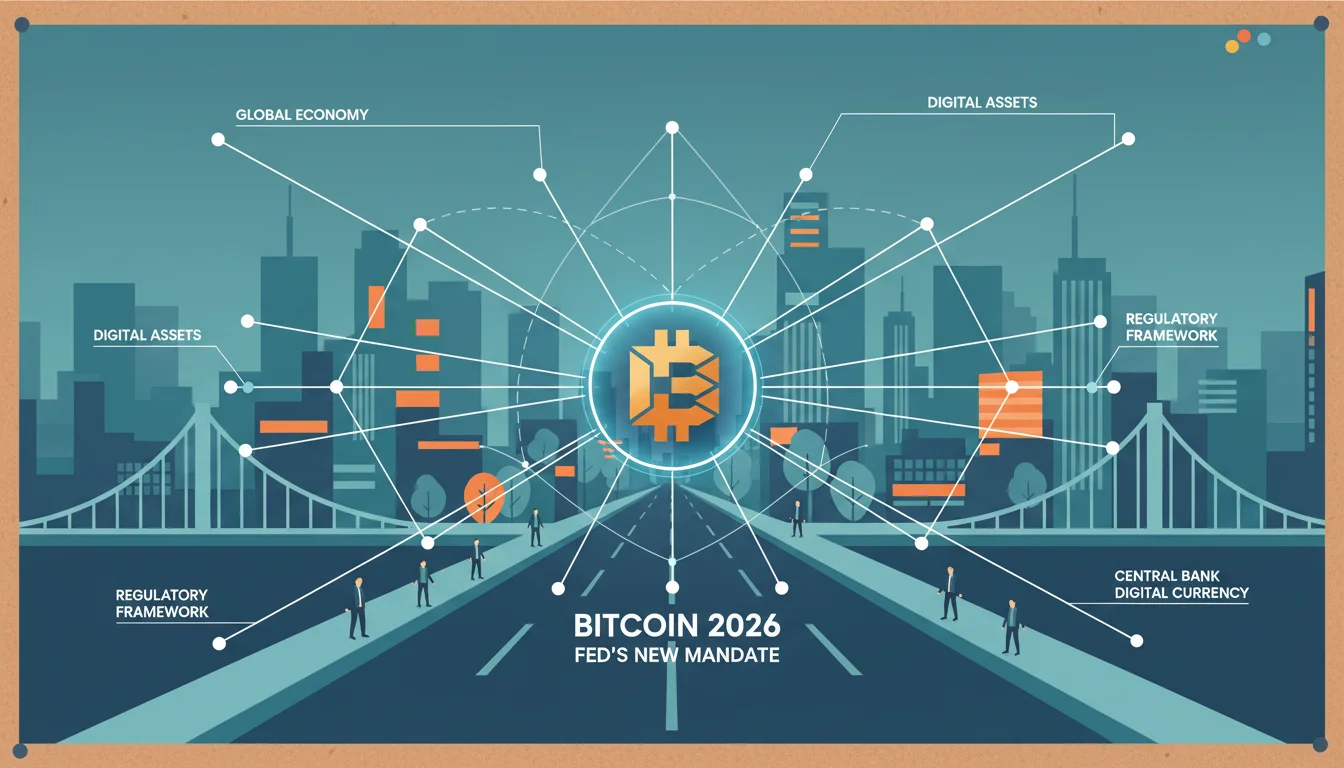
The Federal Reserve’s monetary policy decisions ripple through global financial markets, impacting everything from interest rates to commodity prices. As we look beyond 2026, the long-term outlook for Bitcoin is intricately linked to how the Fed navigates inflation, economic growth, and its own evolving mandate. Understanding these dynamics is essential for anyone considering the future trajectory of digital assets. How will the Fed’s stance on quantitative tightening and interest rates reshape Bitcoin’s role in the global economy?
Key Takeaways
- Sustained higher interest rates post-2026 could increase the opportunity cost of holding non-yielding assets like Bitcoin, potentially moderating speculative demand.
- Increased regulatory clarity from US authorities, potentially influenced by Fed commentary on digital assets, will likely attract more institutional capital to Bitcoin.
- A significant shift in the Fed’s inflation targeting framework, should it occur, could either bolster Bitcoin’s appeal as a hedge or diminish it depending on the framework’s specifics.
- The Fed’s balance sheet reduction, if continued aggressively, may reduce overall market liquidity, impacting risk assets including cryptocurrencies.
- Geopolitical stability, often indirectly influenced by Fed policy and global economic conditions, remains a critical, unpredictable factor for Bitcoin’s long-term price action.
The Fed’s Evolving Mandate and Bitcoin’s Value Proposition
The Federal Reserve operates under a dual mandate: maximizing employment and maintaining stable prices. Historically, these objectives have largely focused on traditional financial metrics and assets. However, the rise of digital assets like Bitcoin presents a new layer of complexity. Post-2026, we can anticipate a continued evolution in how the Fed acknowledges, if not directly addresses, cryptocurrencies within its policy considerations. This isn’t just about direct regulation of digital assets by the Fed, which falls more under legislative bodies and other agencies like the Securities and Exchange Commission (SEC), but rather the indirect influence of macroeconomic policy on Bitcoin’s perceived value.
Consider the Fed’s approach to inflation. If the central bank maintains an aggressive stance on price stability, perhaps even tolerating short periods of higher unemployment to curb persistent inflation, this could strengthen the narrative of Bitcoin as a hedge against fiat currency debasement. Conversely, if the Fed signals a more dovish approach, prioritizing employment growth even at the risk of slightly higher inflation, the urgency for an alternative store of value might diminish for some investors. The market’s perception of the Fed’s commitment to its inflation target directly affects Bitcoin’s appeal. We’ve seen this play out repeatedly over the past few years, where every inflation report and Fed speech causes significant market movements.
On top of that, discussions around a potential central bank digital currency (CBDC) in the United States, while still in preliminary stages, could also factor into Bitcoin’s long-term outlook. A US CBDC would introduce a new digital form of the dollar, potentially altering the competitive field for private digital currencies. While some argue a CBDC could legitimize the broader digital asset space, others contend it might draw liquidity away from decentralized alternatives. The Fed’s stance on this will become clearer over the next few years, and its implications for Bitcoin are still largely speculative, but certainly worth watching.
Interest Rates and Opportunity Cost: A Post-2026 Field
One of the most direct channels through which Fed policy impacts Bitcoin is via interest rates. When the Federal Reserve raises its benchmark federal funds rate, it increases the cost of borrowing across the economy. This, in turn, makes traditional, lower-risk investments like Treasury bonds more attractive. For assets that do not generate yield, such as Bitcoin, the opportunity cost of holding them increases. Post-2026, if we see a sustained period of higher real interest rates, this could present a headwind for Bitcoin’s price appreciation.
Think about it from an institutional investor’s perspective. A pension fund, for example, needs to generate consistent returns to meet its liabilities. If they can achieve a 5% yield on a relatively safe US Treasury bond, allocating capital to a volatile asset like Bitcoin, which yields nothing directly, becomes a tougher sell. This doesn’t mean Bitcoin loses all appeal, but it means its value proposition needs to be even stronger. It needs to demonstrate superior growth potential or serve as a more effective hedge against other risks to justify the increased opportunity cost. According to a report by Reuters in late 2025, many institutional investors were recalibrating their portfolio allocations in anticipation of a prolonged higher-rate environment, leading to a noticeable shift away from purely speculative assets in favor of yield-bearing instruments.
Conversely, a return to a lower interest rate environment, perhaps driven by an economic slowdown or a shift in the Fed’s policy framework, could reduce this opportunity cost. When yields on traditional assets are low, investors often seek higher returns in riskier assets, including cryptocurrencies. Predicting the Fed’s rate trajectory beyond 2026 is challenging, given the multitude of economic variables at play. However, understanding the inverse relationship between real interest rates and speculative asset valuations is fundamental to grasping Bitcoin’s long-term price dynamics. My own analysis suggests that periods of sustained negative real rates historically correlate with stronger performance in assets like Bitcoin, though correlation does not imply causation.
Quantitative Tightening and Market Liquidity
The Fed’s balance sheet operations, specifically quantitative tightening (QT), also play a significant role in overall market liquidity. During QT, the Fed reduces its holdings of Treasury securities and mortgage-backed securities, effectively removing liquidity from the financial system. This process tends to tighten financial conditions, making it more expensive for businesses and consumers to borrow and potentially impacting asset prices across the board, including Bitcoin.
A prolonged period of aggressive QT post-2026 could mean less readily available capital flowing into risk assets. When the market is flush with liquidity, as it was during periods of quantitative easing (QE), investors are often more willing to take on risk. As that liquidity recedes, the appetite for highly volatile assets like Bitcoin can diminish. The impact isn’t always direct and immediate. It often manifests through a general tightening of credit conditions and a re-evaluation of risk premiums by investors. A recent analysis published by the Federal Reserve Bank of New York in early 2026 noted that ongoing balance sheet reduction was having a measurable, albeit gradual, impact on broader financial conditions, indicating a more constrained environment for risk assets.
It’s not just about the absolute level of liquidity, but also the rate of change. Markets tend to react strongly to unexpected shifts in policy. If the Fed were to signal an acceleration or deceleration of QT beyond current expectations, that would likely trigger significant market reactions. For Bitcoin, which is still relatively sensitive to broader market sentiment and liquidity conditions, these shifts could dictate periods of significant volatility or sustained trends. While Bitcoin proponents often tout its independence from traditional finance, the reality is that major macroeconomic shifts still exert considerable influence on its valuation.
Regulatory Field and Institutional Adoption
While the Federal Reserve itself is not the primary regulator of cryptocurrencies, its public statements, research, and general posture towards digital assets can significantly influence the broader regulatory field. Increased clarity from US regulators, whether from the SEC, Commodity Futures Trading Commission (CFTC), or legislative bodies, is widely considered a prerequisite for greater institutional adoption of Bitcoin. The Fed’s willingness to engage with, or even acknowledge, the digital asset space can indirectly signal to other agencies and lawmakers the importance of developing complete frameworks.
For instance, if the Fed were to publish more detailed analyses on the systemic risks or benefits of stablecoins, it could accelerate legislative efforts to regulate them. Such regulation, while not directly impacting Bitcoin, could create a more stable and predictable on-ramp for institutional capital into the broader crypto ecosystem. Conversely, if the Fed maintains a cautious or skeptical stance without offering clear pathways for integration, it might inadvertently slow down broader regulatory progress, thereby hindering institutional inflows into Bitcoin.
The approval of spot Bitcoin Exchange Traded Funds (ETFs) in early 2024 marked a significant milestone, opening doors for broader institutional access. However, the pace of further institutional adoption post-2026 will heavily depend on continued regulatory clarity and the overall macroeconomic environment shaped by Fed policy. If large financial institutions feel confident that the regulatory framework provides adequate consumer protection and market integrity, they are more likely to allocate significant capital to Bitcoin and related products. Without that clarity, even in a favorable macroeconomic environment, many large players will remain on the sidelines.
Geopolitical Factors and Bitcoin’s Safe Haven Narrative
Beyond direct monetary policy, the Federal Reserve’s actions, or inactions, can also indirectly influence geopolitical stability, which in turn impacts Bitcoin’s perceived role as a safe-haven asset. A stable global economy, supported by predictable US monetary policy, generally reduces the demand for alternative assets that thrive on uncertainty. However, in times of geopolitical turmoil or significant economic instability, Bitcoin has often been touted as a digital gold, a decentralized asset immune to the seizure or debasement of national currencies.
If post-2026 sees a period of heightened international tensions, currency crises in emerging markets, or a loss of confidence in traditional financial systems, Bitcoin’s safe-haven narrative could strengthen considerably. The Fed’s decisions on interest rates and quantitative easing/tightening affect global capital flows and the strength of the US dollar, which can have ripple effects on economies worldwide. A strong dollar, for example, can put pressure on countries with dollar-denominated debt, potentially leading to instability that could, paradoxically, boost Bitcoin’s appeal as an uncorrelated asset.
It’s a complex interplay. While some argue that Bitcoin’s price is primarily driven by its own adoption curve and technological developments, its performance during periods of geopolitical stress cannot be ignored. The long-term outlook for Bitcoin is not solely about the Fed’s balance sheet or interest rates. It’s also about how these policies contribute to, or detract from, global financial stability and investor confidence in traditional systems. As a truly global asset, Bitcoin’s trajectory is influenced by many factors, with the Fed’s influence often acting as a significant underlying current.
The interplay between Federal Reserve policy and Bitcoin’s long-term trajectory is complex and multifaceted. Investors should closely monitor the Fed’s communications on inflation, interest rates, and its balance sheet, as these will continue to be significant drivers of market sentiment and capital allocation. A clear understanding of these dynamics allows for more informed decision-making regarding digital asset portfolios.
How do higher interest rates from the Fed affect Bitcoin’s appeal?
Higher interest rates increase the opportunity cost of holding non-yielding assets like Bitcoin. When safer investments, such as Treasury bonds, offer attractive returns, investors may be less inclined to allocate capital to volatile assets that do not generate passive income.
What is quantitative tightening (QT) and how might it impact Bitcoin post-2026?
Quantitative tightening is when the Federal Reserve reduces its holdings of assets, thereby removing liquidity from the financial system. Post-2026, sustained QT could lead to tighter financial conditions and reduced overall market liquidity, potentially dampening investor appetite for risk assets like Bitcoin.
Could a US central bank digital currency (CBDC) impact Bitcoin’s long-term outlook?
A US CBDC could introduce a new digital form of the dollar, potentially altering the competitive field for private digital currencies. While some believe it could legitimize the broader digital asset space, others suggest it might draw liquidity away from decentralized alternatives like Bitcoin, though the exact impact remains to be seen.
How does the Fed’s stance on inflation influence Bitcoin’s value proposition?
If the Fed maintains an aggressive stance on curbing inflation, it might reduce the perceived need for Bitcoin as a hedge against fiat currency debasement. Conversely, if the Fed adopts a more dovish approach, tolerating higher inflation, Bitcoin’s appeal as an inflation hedge could strengthen.
Will increased regulatory clarity in the US, influenced by the Fed, benefit Bitcoin?
Yes, increased regulatory clarity from US authorities, often indirectly influenced by the Fed’s broader engagement with digital assets, is expected to attract more institutional capital to Bitcoin. A predictable regulatory environment reduces uncertainty for large investors, encouraging greater adoption.