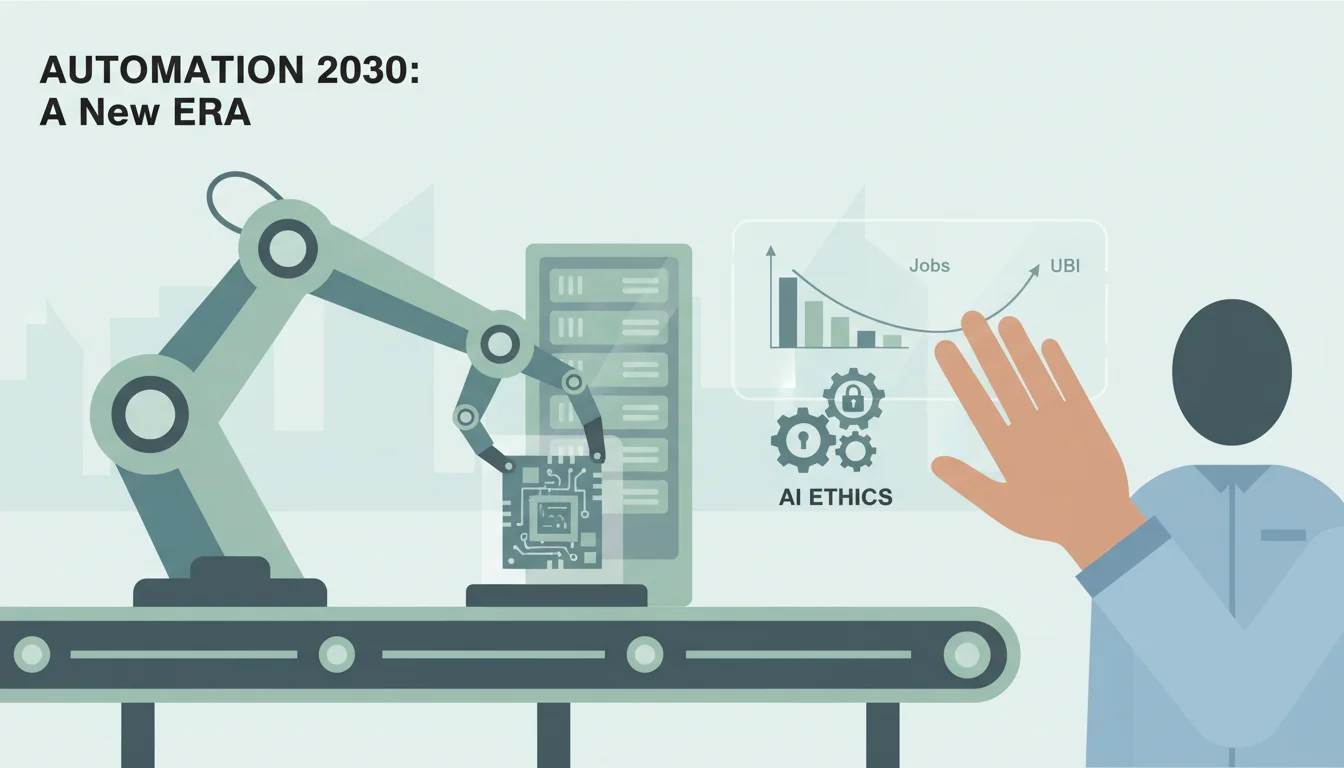
The future of work is being fundamentally reshaped by advancements in automation. We are not just talking about robots on assembly lines anymore; intelligent systems now handle complex tasks, impacting industries from healthcare to finance. This shift raises questions about job security, economic structures, and the very nature of human employment. Can societies adapt to this rapid transformation, or will we face widespread job displacement and unprecedented social upheaval?
Key Takeaways
- By 2030, an estimated 20 million manufacturing jobs globally could be replaced by robots, according to Oxford Economics.
- Governments and educational institutions must prioritize lifelong learning initiatives and reskilling programs to address the skills gap created by automation.
- The emergence of “cobots” (collaborative robots) indicates a growing trend towards human-AI teamwork rather than complete human replacement in many sectors.
- Universal Basic Income (UBI) and other social safety nets are increasingly discussed as potential solutions to mitigate economic disruption from widespread automation.
- Ethical frameworks for AI development and deployment are essential to ensure automation benefits society broadly and prevents exacerbating existing inequalities.
“By 2035, more than a third of China's population will be over 60, according to official estimates. The country will also lose nearly 60 million people in the next decade – almost equivalent to the population of France – according to some estimates.”
The Shifting Sands of Employment: Beyond Repetitive Tasks
Automation’s impact extends far beyond the factory floor. While repetitive, manual tasks were the first to be automated, today’s artificial intelligence (AI) systems are capable of cognitive work once thought exclusively human. Think about legal discovery, medical diagnostics, or even creative content generation. These systems process vast amounts of data, identify patterns, and make predictions with accuracy that often surpasses human capabilities. This isn’t just about efficiency; it’s about a fundamental restructuring of how work gets done.
Consider the legal sector. AI-powered platforms can review thousands of documents for relevant information in minutes, a task that would take human paralegals weeks. This doesn’t eliminate the need for lawyers, but it certainly changes their role. They become strategists, interpreters, and negotiators, rather than data processors. The value shifts from sheer volume of work to nuanced judgment and complex problem-solving. This pattern repeats across many professional services: the routine elements are automated, leaving the more creative, interpersonal, and strategic aspects for humans. This requires a different skill set from the workforce, and our educational systems are, frankly, struggling to keep pace.
Job Displacement and the New Skill Imperative
The most immediate and concerning societal impact of automation is job displacement. While some argue that automation creates new jobs to offset those lost, the transition is rarely smooth or equitable. The new jobs often require different skills, geographic relocation, or higher levels of education than the displaced workers possess. This creates a significant challenge for policymakers and educators. According to a 2023 report by the World Economic Forum, automation is projected to displace 85 million jobs globally by 2025, while creating 97 million new ones. That net gain sounds positive, but the mismatch between the skills required for new roles and the skills of displaced workers is the critical issue. It’s not a simple one-for-one swap.
We are seeing this play out in various sectors. In logistics, for instance, warehouse workers are being replaced by autonomous robots that sort, pick, and pack goods. The new jobs emerging are for robot maintenance technicians, AI trainers, and data analysts. These roles are often higher-skilled and command better wages, but they are inaccessible to many existing warehouse employees without significant retraining. The onus falls on individuals to adapt, but also on governments and corporations to provide accessible pathways for reskilling. Without proactive measures, we risk widening economic inequality and creating a permanent underclass of workers whose skills are no longer valued by the automated economy. This is not a hypothetical; it’s happening right now, and the pace will only accelerate.
The Rise of Human-AI Collaboration: Cobots and Augmented Intelligence
While the narrative often focuses on robots replacing humans, a more nuanced reality involves human-AI collaboration. “Cobots,” or collaborative robots, work alongside human employees, assisting with tasks rather than fully taking them over. This model combines the precision, speed, and tireless nature of machines with human creativity, adaptability, and critical thinking. In manufacturing, cobots can handle heavy lifting or repetitive assembly, allowing human workers to focus on quality control, customization, or complex problem-solving. This isn’t just about making humans more efficient; it’s about making their work more engaging and less physically demanding.
Beyond physical collaboration, augmented intelligence tools are becoming commonplace in knowledge work. These AI systems assist professionals by analyzing data, generating insights, and automating routine cognitive tasks. For example, in healthcare, AI can help radiologists detect subtle anomalies in medical images, or assist doctors in reviewing patient histories to identify potential drug interactions. The human expert remains the decision-maker, but their capabilities are significantly enhanced by AI. This approach suggests a future where AI isn’t a competitor but a powerful tool, extending human potential rather than limiting it. The challenge here is ensuring that humans remain central to the decision-making process, especially in fields where ethical considerations are paramount. We must avoid a future where human judgment is entirely outsourced to algorithms, no matter how sophisticated.
Rethinking Social Safety Nets and Economic Structures
The profound changes brought by automation necessitate a serious re-evaluation of our social and economic structures. If a significant portion of traditional employment becomes automated, how will societies ensure economic stability and individual well-being? Discussions around Universal Basic Income (UBI) are gaining traction as a potential solution. UBI provides a regular, unconditional income to all citizens, irrespective of their employment status. Proponents argue it could provide a safety net, reduce poverty, and allow individuals to pursue education, entrepreneurship, or caregiving roles without financial duress. Critics raise concerns about its cost, potential disincentives to work, and inflationary pressures.
Beyond UBI, other policy considerations include investing heavily in public education and lifelong learning programs, exploring shorter workweeks, and reforming tax systems to potentially tax automated labor or the profits generated by AI. The goal must be to ensure that the economic benefits of automation are broadly shared, rather than concentrated in the hands of a few. This requires bold political will and a willingness to experiment with new models. We cannot simply cling to 20th-century economic paradigms in a 21st-century automated world. The alternative is social unrest and deepening divisions, which no society can afford.
Ethical Imperatives and the Future of Human Agency
As automation becomes more pervasive, the ethical implications become increasingly complex. Questions about algorithmic bias, data privacy, and accountability for AI decisions are paramount. If AI systems are trained on biased data, they will perpetuate and even amplify those biases in their outputs, leading to unfair outcomes in areas like hiring, lending, or even criminal justice. Ensuring transparency in AI decision-making, developing robust ethical guidelines, and establishing clear lines of accountability are not optional; they are essential for maintaining public trust and preventing harm. This is a responsibility that falls on developers, corporations, and governments alike. We need regulatory frameworks that are agile enough to keep pace with technological advancement, yet firm enough to protect fundamental human rights.
Moreover, we must consider the impact of automation on human agency and purpose. If machines handle more and more tasks, what does it mean to be human? How do we find meaning and fulfillment in a world where traditional work may be less central to our identity? These are not merely philosophical questions; they are practical challenges that will define the coming decades. Cultivating skills like creativity, critical thinking, emotional intelligence, and interpersonal communication will become even more valuable, as these are the domains where human superiority remains unchallenged. The future of work isn’t just about technology; it’s about redefining our relationship with it and with each other.
The ongoing integration of automation into our workplaces presents both unprecedented challenges and remarkable opportunities. Navigating this transformation requires proactive policy, adaptable education, and a commitment to ethical development. Societies that embrace lifelong learning and foster human-AI collaboration stand to thrive. The key is to see automation not as an endpoint, but as a tool to reshape work for the better, making it more efficient, safer, and ultimately, more human-centric.
What types of jobs are most at risk from automation?
Jobs involving highly repetitive, predictable tasks, both manual and cognitive, are most susceptible to automation. This includes roles in manufacturing, data entry, administrative support, and some aspects of logistics and customer service. However, even complex jobs are seeing automation of their routine components.
Will automation create more jobs than it displaces?
Forecasters like the World Economic Forum suggest a net gain in jobs globally, but with a significant mismatch between the skills of displaced workers and those required for new roles. The challenge is not necessarily a lack of jobs, but a lack of accessible pathways for reskilling workers to fill them.
What is Universal Basic Income (UBI) and how does it relate to automation?
UBI is a government program where all citizens receive a regular, unconditional income, regardless of their work status. It is often discussed as a potential solution to economic disruption caused by widespread job displacement due to automation, providing a safety net and allowing individuals to pursue new opportunities.
How can individuals prepare for the automated future of work?
Individuals should focus on developing skills that are less easily automated, such as creativity, critical thinking, emotional intelligence, complex problem-solving, and interpersonal communication. Lifelong learning, continuous upskilling, and adaptability are also crucial for navigating career changes.
What role do ethics play in the development of automation and AI?
Ethical considerations are paramount to ensure AI systems are developed and deployed responsibly. This includes addressing algorithmic bias, protecting data privacy, establishing accountability for AI decisions, and ensuring that automation benefits society broadly without exacerbating inequalities or undermining human agency.



