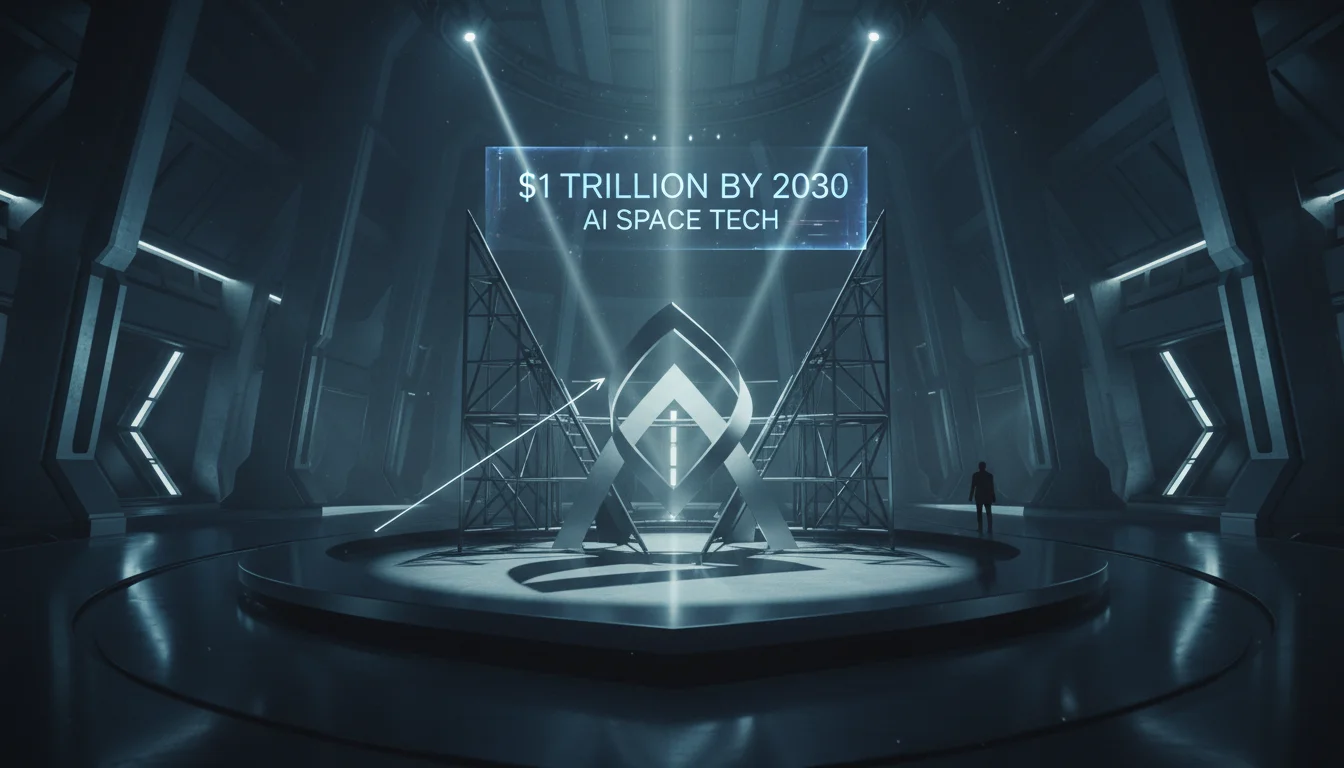
The space industry isn’t just for governments anymore. Private money is pouring in, and the main reason is the practical application of AI space tech. From self-working through spacecraft to smart data analysis, artificial intelligence is changing how we explore, use, and most importantly, invest in space. This integration is opening up new opportunities and accelerating the timeline for a multi-planetary future, but where is the smart money actually going?
Key Takeaways
- Expect global investment in space to top $1 trillion by 2030, with AI being the main engine for that growth.
- AI analytics are absolutely necessary for making sense of the 2.5 exabytes of satellite data produced every day, turning that raw feed into something investors can act on.
- VCs are chasing autonomous robotics and AI-powered manufacturing in orbit because they promise to slash launch costs and let us use resources found in space.
- Pairing AI with new propulsion systems like electric propulsion is making deep-space missions cheaper, more efficient, and happen faster.
- Investors are putting money into companies using AI to manage space junk, because they know sustainable orbital operations are a prerequisite for everything else.
The AI Imperative in Space Exploration and Investment
The sheer scale of space operations makes AI essential. Just look at the data problem: our satellites already generate terabytes of information daily, and with all the new constellations going up, that’s set to grow exponentially. Without smart AI algorithms, it would be physically impossible to go through that firehose of data and find anything useful. This information, everything from Earth observation images for farming to telemetry from probes in deep space, represents a real goldmine for science and business. The companies that can process this data with AI are the ones getting the funding.
For example, firms specializing in AI-driven geospatial intelligence are attracting a lot of cash. They use machine learning to scan satellite photos for patterns related to climate change, city growth, or even economic activity. A recent BryceTech (an aerospace consulting firm) report showed private investment in companies using AI for Earth observation shot up 35% in 2025 alone, hitting over $4 billion. This provides actionable intelligence to industries from finance to logistics, creating clear returns on investment.
Beyond just crunching numbers, AI is also becoming fundamental to actually running the missions. Autonomous systems are taking over spacecraft maneuvers, spotting faults, and even calibrating scientific instruments on the fly. This means less need for constant babysitting from the ground, which cuts operational costs and makes missions more strong. The European Space Agency (ESA), for instance, has been putting real money into AI research for autonomous rendezvous and docking. Why? Because that’s a make-or-break capability for future orbital servicing and construction. This isn’t a future dream. It’s being tested now and drawing serious capital.
Autonomous Systems and In-Orbit Manufacturing: A New Economic Frontier
One of the most exciting investment areas for AI space tech is in autonomous systems and in-orbit manufacturing. Self-assembling structures, robotic repair crews, even 3D printing facilities operating in a vacuum, these are quickly becoming engineering problems to be solved, not science fiction. This shift will completely change the economics of space, breaking our dependence on expensive, high-risk Earth launches for every single part.
Robots run by advanced AI are the centerpiece of this whole idea. Picture this: a satellite has a critical failure. Instead of writing it off and launching a new multi-million dollar replacement, an AI-controlled robot could go up, diagnose the problem, and perform repairs or swap in a new part. This is on-orbit servicing, and it’s a real market. Companies like Orbit Fab which is building out in-space refueling services, are proving this is commercially viable. A 2025 forecast from Northern Sky Research (NSR) sees the in-orbit servicing market hitting $4.5 billion a year by 2032, and AI is central to the mission planning and execution.
AI is also the key to making in-space manufacturing happen. Instead of designing parts to survive a violent launch, we can build them in orbit, maybe even using materials mined off-world. AI algorithms can optimize a design for a zero-gravity environment, run the robotic 3D printers, and handle quality control. This enables building larger structures (think huge solar arrays or deep-space habitats) and it also drops the cost per kilogram of material you have in space. Investors are watching the startups developing AI-powered 3D printers for space very closely, because they’re the ones who will build the new supply chains for deep-space exploration. This enables missions that were just impossible before because of launch size or mass constraints.
The Role of AI in Satellite Constellations and Connectivity
The explosion of satellite constellations, especially for global internet, is another huge driver of space investment, and AI is at the heart of it. Companies like SpaceX’s Starlink and Amazon’s Project Kuiper are launching thousands of satellites to bring broadband to places that have never had it. You can’t manage a network that big, keep it performing well, and stop satellites from hitting each other without a serious amount of automation.
AI algorithms are what orchestrate these mega-constellations. They do everything from dynamically steering beams to give users the best signal, to commanding individual satellites to dodge each other automatically. With tens of thousands of active satellites expected in orbit by the end of the decade, trying to do traffic control manually is a non-starter. AI systems watch orbital paths 24/7, predict close calls, and execute tiny, fuel-efficient avoidance burns without a human ever getting involved. This capability is a fundamental safety requirement for keeping low Earth orbit (LEO) usable.
On top of that, AI is changing how the data gets back to Earth. Edge computing, where an AI processes data right on the satellite before sending anything down, is becoming standard. This cuts down on the raw data you need to downlink, saving bandwidth and getting insights faster. For example, a satellite watching farms could use its onboard AI to spot crop stress and just send an alert instead of terabytes of raw images. This kind of smart data handling makes the constellations more valuable, which attracts more investment. The entire future of space-based connectivity depends on getting these intelligent networks right.
AI-Powered Propulsion and Deep-Space Missions
Most of the AI space tech investment is focused on Earth orbit right now, but its effect on propulsion and deep-space missions is just as big. AI is making our trips beyond Earth more efficient and ambitious by expanding our exploration possibilities.
Take a look at advanced propulsion like electric propulsion (ion or Hall effect thrusters). These things are incredibly fuel-efficient but don’t have a lot of punch. AI can optimize their performance, tweaking thrust and trajectory in real time to either cut down travel time or let you pack more gear. For a mission to Mars or the outer planets, where every gram of propellant counts, this is a huge deal. Researchers at places like NASA’s Jet Propulsion Laboratory are building AI models to predict when parts in these thrusters might fail, letting them run longer and more reliably.
For deep-space probes, AI is becoming the co-pilot. It can take minutes or even hours for a signal to reach a distant spacecraft, so you can’t joystick it from Earth. AI systems onboard are now handling autonomous navigation, picking science targets, and reacting to surprises. A probe that can make its own smart decisions in response to its environment leads to more resilient missions that can hit more ambitious science targets. Investors know that companies building tough, radiation-hardened AI for these jobs are set for serious growth as we push further into the solar system. It’s about what we can actually do once we arrive.
Working through the Challenges: Cybersecurity and Space Debris
While the opportunities in AI space tech are huge, the sector has serious challenges that also need smart solutions, and those solutions are attracting strategic investment. Two of the biggest worries are cybersecurity and the growing cloud of space debris.
As our satellites get more connected and AI-dependent, they become bigger targets for cyberattacks. A hacked satellite could mean lost data, service disruptions, or even a collision. That’s why we’re seeing a rapid increase in funding for AI-powered cybersecurity designed for space. This includes AI that hunts for weird network activity, flags potential hacks, and takes defensive action on its own. Companies working on quantum-resistant encryption for satellite links, often using AI to manage the keys, are getting a lot of investor attention. Protecting these space assets is non-negotiable for the growth of the future economy in space.
Space debris is the other five-alarm fire, and AI is a critical tool for fighting it. There are tens of thousands of dead satellites, old rocket stages, and tiny fragments circling the Earth, and they’re a massive collision risk. AI is being used to track and predict debris paths more accurately, to plan dodges for active satellites, and to develop missions to actively clean up the junk. Engineers are designing AI-driven robotic claws and nets to go grab the biggest pieces of garbage and pull them out of orbit. This is an economic concern. One bad collision could make an entire orbital altitude unusable, threatening billions of dollars in hardware. So investors are backing companies with real, AI-based solutions for debris removal, because a sustainable space environment is foundational to everything else. It’s a pragmatic necessity.
AI integration is the driving force behind the space industry’s expansion and the new investment that follows. By enabling new levels of autonomy, data analysis, and efficiency, AI is unlocking the full potential of space and creating a strong future economy. Investors should focus on companies applying AI to intelligent data processing, autonomous orbital operations, and the long-term sustainability of space.
Most relevant AI types for space technology:
Machine learning, especially deep learning for image recognition and making predictions, is key for satellite data. We use reinforcement learning for teaching robots and spacecraft to fly themselves, and neural networks are all over the place, from optimizing engine burns to spotting when something’s about to break.
How AI reduces space mission costs:
AI cuts costs by letting spacecraft run themselves (less expensive human oversight), planning fuel-sipping trajectories, predicting when parts will fail so missions last longer, and enabling in-orbit manufacturing so we don’t have to launch everything from Earth. All those efficiencies add up to cheaper missions.
Biggest investment opportunities in AI space tech:
The big money is flowing into a few key areas: AI-powered data analytics for Earth observation, autonomous robots for fixing and building things in orbit, AI for managing huge satellite constellations, and tech that tackles space debris and cybersecurity. If a company is doing something smart in one of those areas, they’re getting funded.
AI in space defense applications:
Yes, absolutely. AI is being used heavily for space domain awareness, tracking every object in orbit, spotting potential threats, and making national space assets more resilient. This includes using AI to detect weird satellite behavior and to plot defensive moves against hostile actions.
Ethical considerations for AI in space:
The main ethical issues involve making sure we can understand and trust AI decisions, especially from autonomous systems that control important hardware. We also have to worry about biases in the data used to train AIs, and there’s a serious need for international discussion and rules about developing autonomous weapons in space.



